French pastries represent the pinnacle of baking artistry—delicate, buttery, and impossibly elegant. As someone who trained in Paris and has spent over a decade perfecting these techniques, I'm often asked: "Can I really make these at home?" The answer is absolutely yes—with the right guidance, patience, and practice.
Today, I'm sharing the professional secrets and techniques that will transform your home baking from ordinary to extraordinaire. While French pastry has a reputation for being intimidating, I promise that understanding the fundamentals makes everything achievable.
The Foundation: Understanding Laminated Dough
At the heart of many French pastries—croissants, pain au chocolat, danishes—is laminated dough. This technique involves folding butter into dough multiple times to create hundreds of thin, alternating layers. When baked, the butter releases steam, causing the layers to separate and creating that characteristic flaky texture.
The Three Keys to Perfect Lamination:
- Temperature control: Your butter and dough must be at similar temperatures (cold but pliable). Too warm, and the butter will melt into the dough. Too cold, and it will break into chunks.
- Precision: Even pressure when rolling, exact measurements, and consistent thickness ensure uniform layers.
- Patience: Rest periods between folds are non-negotiable—they allow gluten to relax and prevent shrinkage.
Mastering Croissants: The Ultimate Test
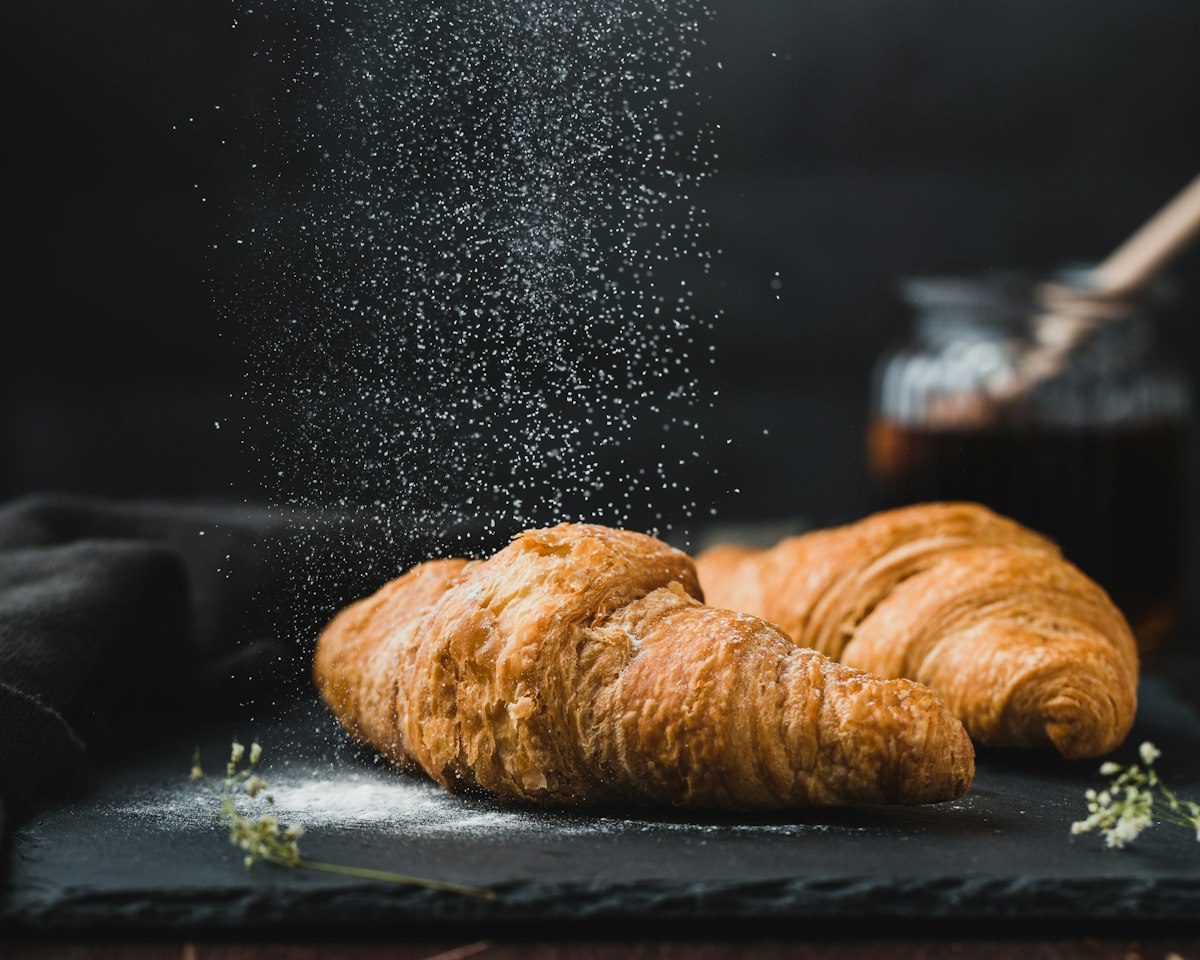
Croissants are considered the gold standard of pastry-making. When done right, they're light, airy, buttery, and shatter delicately at first bite. Here's my professional approach:
The Dough (Détrempe):
Start with a basic dough of flour, water, yeast, sugar, salt, and a small amount of butter. This forms the foundation. Mix until just combined—overworking develops too much gluten, making rolling difficult.
Pro tip: Use European-style butter with at least 82% butterfat. The higher fat content means less water, which creates flakier pastries.
The Butter Block (Beurrage):
Pound cold butter between parchment paper into a precise square. This technique ensures even distribution during folding. The butter should be cold but pliable—think the texture of marzipan.
The Folds (Tours):
Traditional croissant dough receives three "turns," each consisting of rolling the dough into a rectangle and folding it in thirds (like a letter). Between each turn, rest the dough in the refrigerator for at least 30 minutes.
The math: Three letter folds create 27 layers of butter (3×3×3). Some pastry chefs add a fourth turn for 81 layers, though I find 27 layers optimal for croissants.

Shaping & Proofing:
Roll the finished dough to about 3-4mm thickness. Cut into triangles and roll from the wide end to the point, creating the classic crescent shape. Proof until nearly doubled—this takes 2-3 hours at room temperature. The croissants should feel airy and jiggly.
Common mistake: Under-proofing leads to dense, doughy croissants. Over-proofing causes them to collapse in the oven. They're ready when they wobble slightly when the pan is moved.
Baking:
Brush with egg wash (1 egg + 1 tablespoon cream) and bake at 200°C (400°F) for 15-18 minutes until deep golden brown. Don't open the oven door during the first 10 minutes—you'll release steam needed for rise.
Éclairs & Choux Pastry: The Science of Steam
Choux pastry is unique—it contains so much moisture that it creates its own rise through steam. This is the base for éclairs, cream puffs, profiteroles, and Paris-Brest.
The Process:
- Cook the paste: Bring water, butter, and salt to a boil. Add flour all at once and stir vigorously until the mixture forms a ball and pulls away from the pan sides.
- Cool slightly: Transfer to a bowl and let cool for 2-3 minutes—too hot, and you'll cook the eggs.
- Add eggs gradually: Beat in eggs one at a time until the paste reaches the perfect consistency—smooth, glossy, and slowly falling from a spatula in a thick ribbon.
- Pipe precisely: Use a piping bag with a plain tip. For éclairs, pipe 10-12cm strips. For cream puffs, pipe rounds.
- Bake hot, then lower: Start at 220°C (425°F) for 10 minutes to create steam, then reduce to 180°C (350°F) to dry the interior without over-browning.
The golden rule: Don't open the oven until pastries are golden and look set. Opening early causes collapse.
Filling Éclairs:
Classic pastry cream (crème pâtissière) is made from milk, sugar, eggs, cornstarch, and butter, flavored with vanilla. For éclairs:
- Vanilla: Madagascar vanilla bean for the most authentic flavor
- Chocolate: Add melted dark chocolate to pastry cream
- Coffee: Dissolve instant espresso in hot milk before adding
- Pistachio: Fold in pistachio paste
Fill using a piping bag inserted from one end, and top with fondant glaze in coordinating flavors.
Tarts: Precision in Simplicity
French tarts showcase fruit at its finest—arranged with precision on a base of pastry cream or frangipane.
Pâte Sucrée (Sweet Tart Dough):
This enriched dough contains more butter and sugar than standard pie dough, creating a cookie-like crust. The technique:
- Cream butter and sugar
- Add egg and vanilla
- Mix in flour until just combined
- Rest for at least 1 hour (overnight is better)
- Roll between parchment paper to prevent sticking
- Blind bake with weights until golden
Pro secret: Freeze the dough briefly after pressing into the pan. This helps maintain shape during baking.
Assembly & Glazing:
Fill the baked shell with pastry cream or almond cream (frangipane). Arrange fruit in precise patterns—concentric circles for berries, overlapping scales for apples or pears. Brush with apricot glaze (heated apricot jam strained through a sieve) for shine and preservation.
Macarons: The Art of Meringue
French macarons have a mystique, but once you understand the science, they become much more approachable.
The Italian Meringue Method (My Preferred Technique):
This method is more stable and forgiving than the French method:
- Make almond flour/powdered sugar mixture (tant pour tant)
- Mix with egg whites to form a paste
- Make Italian meringue by pouring hot sugar syrup (118°C/244°F) into whipping egg whites
- Fold meringue into almond paste (macaronage) until lava-like consistency
- Pipe into rounds and bang pan on counter to release air bubbles
- Rest until a skin forms (30-60 minutes)—essential for the "feet"
- Bake at 150°C (300°F) for 12-15 minutes
Troubleshooting Macarons:
- Hollow shells: Over-mixed batter or oven too hot
- No feet: Under-mixed batter, didn't form skin, or oven too cool
- Cracked tops: Oven too hot or didn't release air bubbles
- Lopsided: Uneven oven temperature or incorrect piping angle
Essential Equipment for Home Pastry Success
While professional kitchens are fully equipped, home bakers can achieve excellent results with a few key tools:
- Digital scale: Baking is chemistry—volume measurements are imprecise
- Rolling pin: French rolling pins (tapered, no handles) offer better control
- Bench scraper: For cutting dough and keeping work surface clean
- Offset spatula: Essential for spreading and smoothing
- Piping bags and tips: Various sizes for different applications
- Instant-read thermometer: Critical for sugar work and pastry cream
- Silicone mats: Non-stick surfaces for macarons and pastries
- Pastry brush: For egg wash and glazes
Ingredient Quality Matters
In French pastry, where recipes are simple and technique-focused, ingredient quality shines through:
- Butter: Use European-style with high butterfat (82% or higher)
- Eggs: Fresh, room temperature eggs emulsify better
- Flour: French pastry flour (T45) or cake flour for delicate pastries; all-purpose for sturdier ones
- Vanilla: Real vanilla beans or high-quality extract—never imitation
- Chocolate: Valrhona, Callebaut, or other high-quality couverture
Practice Makes Perfect
When I first arrived in Paris as an apprentice, my croissants were disasters—dense, greasy, misshapen. My chef told me something I'll never forget: "Alexandru, a pastry chef is made through 10,000 croissants. You've made 12. Keep going."
He was right. Pastry is a craft honed through repetition. Each batch teaches you something—how the dough should feel, how to recognize proper consistency, when something needs more time or less heat.
My advice: Start with one recipe. Make it once a week for a month. By the fourth attempt, you'll notice improvement. By the tenth, you'll feel confident. By the twentieth, you'll have mastered it.
Common Mistakes to Avoid
- Rushing: Pastry requires patience. Rest times exist for scientific reasons.
- Incorrect temperatures: Too warm destroys butter layers; too cold makes rolling impossible.
- Skipping the scale: Cups and spoons are inadequate for precision baking.
- Opening the oven: Resist the temptation—wait until the minimum baking time has elapsed.
- Fear of failure: Even professionals have bad days. Learn from mistakes and try again.
Final Thoughts
French pastry is a journey, not a destination. Each technique mastered opens doors to countless variations. Croissants lead to pain au chocolat, danishes, and kouign-amann. Choux pastry evolves into éclairs, cream puffs, Paris-Brest, and croquembouche. Tart dough becomes the base for endless seasonal creations.
At Lake Champlain Bakery, we honor these traditions daily, but we also encourage home bakers to explore this beautiful craft. There's profound satisfaction in pulling a tray of golden croissants from your oven, hearing them crackle as they cool, and sharing them with loved ones.
The techniques I've shared today took me years to master, but they're all within your reach. Start simple, be patient with yourself, and remember: every expert was once a beginner.
Want to Learn in Person?
Join our pastry workshops where we teach these techniques hands-on in our professional bakery.
Inquire About Workshops